Designing for the Auckland Sky
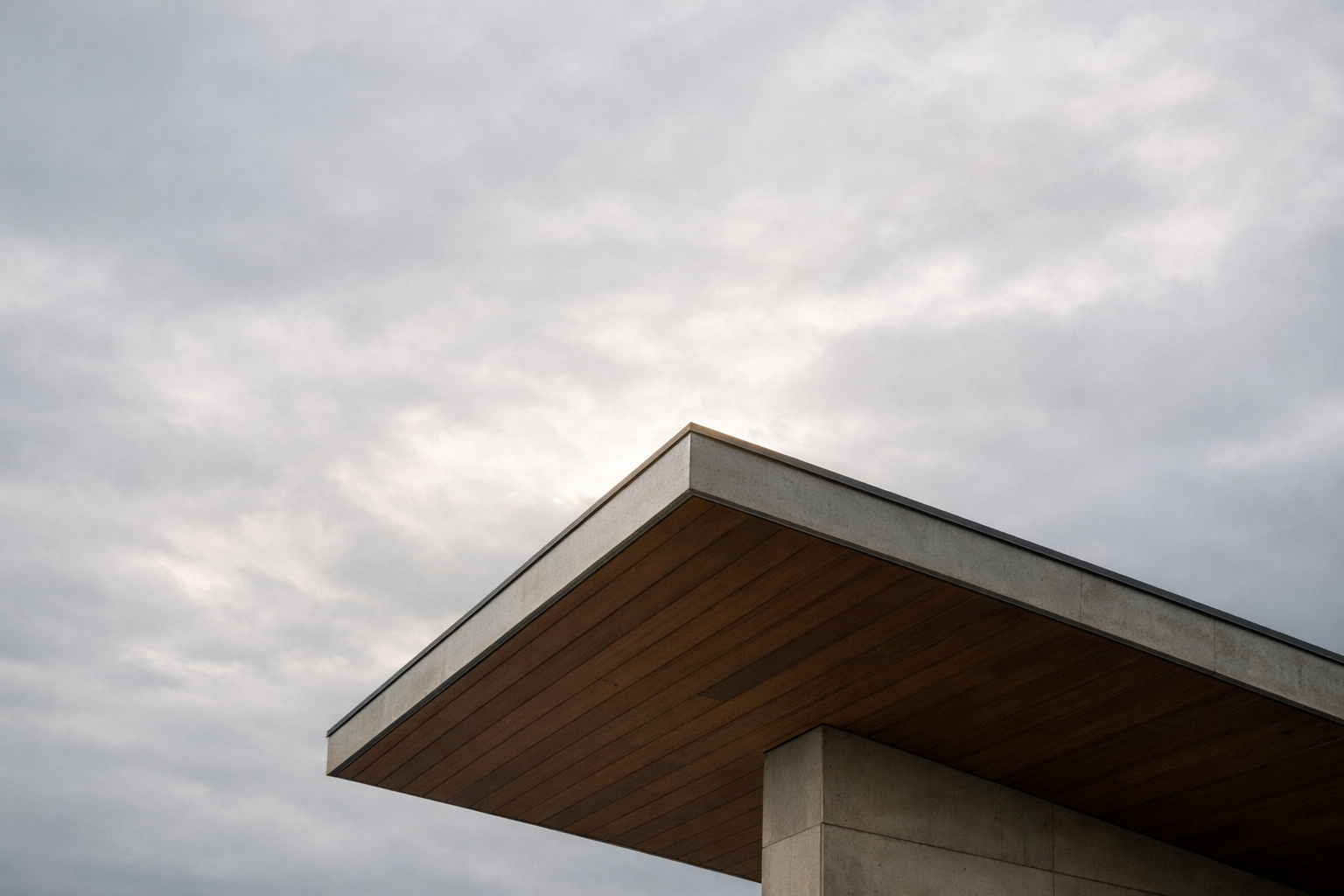
Auckland is often described through its geography: the harbours, the volcanic cones, the thin isthmus stretched between two bodies of water. But less often do we speak about the sky, even though it is arguably the most constant presence in our daily lives.
The Auckland sky is not dramatic in the way of alpine peaks or desert horizons. It is rarely sharp or harsh. Instead, it is soft, layered, humid, and shifting. It is a sky of moisture and movement. A sky that filters light rather than flooding spaces with it. A sky that asks architecture to respond quietly, intelligently, and with restraint.
To design well in Auckland is to design for this sky.
A City of Diffuse Light
Unlike cities blessed with crisp Mediterranean sun or long, dry seasons, Auckland lives beneath a veil. Cloud cover is frequent, and light is often diffused, scattered through layers of moisture and atmosphere. This produces a gentle, even illumination that is forgiving but also subtle. Shadows soften. Contrast lowers. Edges blur.
This has profound architectural implications.
Spaces designed for hard, directional sunlight often feel flat or lifeless here. Deep overhangs can become unnecessarily defensive. Dark interiors struggle to come alive. Conversely, architecture that embraces softer light, through generous openings, pale and tactile materials, and careful modulation rather than control, begins to glow from within.
In Auckland, light rarely arrives as a spotlight. It arrives as an ambient condition. Architecture should not fight this, but tune itself to it.
Humidity as a Design Condition
Humidity is often treated as a technical problem to be solved: ventilation rates, vapour barriers, mechanical systems quietly working in the background. But humidity is also a sensory condition. It changes how spaces feel on the skin. It slows the air. It amplifies smells. It softens sound.
Timber behaves differently in this climate. Stone and masonry hold moisture in subtle ways. Metal weathers, patinas, and dulls. Architecture here is never static, it is always in conversation with moisture.
Designing for the Auckland sky means acknowledging that buildings are not sealed objects. They breathe, absorb, and release. Details matter: deep eaves, sheltered thresholds, covered outdoor rooms, and moments where inside and outside blur rather than abruptly divide.
This is not about nostalgia or rusticity. It is about comfort that feels natural rather than engineered.
Cloud as Ceiling
On many days, the sky in Auckland feels low. Clouds move quickly, sometimes dramatically, sometimes barely perceptibly. They form a kind of living ceiling above the city, constantly reshaping the quality of space below.
This lends weight to horizontality. Long rooflines, extended verandas, and low-slung forms sit comfortably beneath this sky. Architecture that is overly vertical or aggressively iconic can feel disconnected from its atmospheric context.
There is a quiet confidence in buildings that sit under the sky rather than reach for it.
Courtyards, covered walkways, and sheltered outdoor spaces become essential. They allow us to inhabit the edge between exposure and protection, a place where the sky is present but not overwhelming.
The Colour of the Sky
Auckland’s sky is rarely blue in the postcard sense. It is silver, pale grey, soft white, sometimes greened by reflected landscape or sea. At dusk, it can turn peach, lavender, or smoky gold. These colours seep into architecture whether we intend them to or not.
Highly saturated materials can feel jarring beneath this sky. Reflective surfaces often dominate rather than participate. More muted palettes, timber, limewash, clay, soft stone, natural metals, allow the building to act as a receptor rather than a declaration.
This is not about being timid. It is about resonance.
When architecture reflects the colours of the sky, it feels grounded. When it ignores them, it can feel imported, designed for somewhere else.
Rain as Rhythm
Rain is not an interruption in Auckland; it is a rhythm. It arrives suddenly, passes quickly, returns again. It changes how streets sound, how gardens smell, how light behaves.
Architecture that treats rain as an inconvenience often ends up defensive and closed. Architecture that treats rain as part of daily life becomes richer: deep thresholds where you can pause, gutters and chains that make sound, windows you can safely open while it rains, outdoor rooms that remain usable in wet weather.
Designing for the Auckland sky means designing for rain as an experience, not just a load case.
A Softer Kind of Resilience
Much of the conversation around climate-responsive architecture focuses on extremes: heatwaves, storms, floods. These matter, and Auckland will increasingly need to respond to them. But resilience here is also about the everyday, the thousands of mild, damp, overcast days that define how spaces are actually lived in.
Buildings that rely on constant artificial lighting, sealed interiors, and mechanical correction tend to feel draining over time. Those that work with ambient light, natural airflow, and material honesty tend to feel restorative.
This is where biophilic thinking becomes less about greenery as decoration and more about attunement. The sky becomes part of the design brief. Not as an image, but as a condition.
Architecture as Atmospheric Instrument
Good architecture in Auckland does not dominate the skyline. It listens to it.
It frames the sky through windows and courtyards. It softens transitions between inside and out. It chooses materials that age gracefully under cloud and moisture. It accepts that perfection will fade, and that patina is not failure but evidence of belonging.
In this way, buildings become atmospheric instruments, tuning forks that resonate with light, air, and weather.
This is not a limitation. It is an opportunity.
Designing From Where We Are
Too often, architecture in Auckland borrows its language from elsewhere: climates with harder sun, clearer skies, and drier air. The result can be buildings that photograph well but feel unresolved in daily use.
Designing for the Auckland sky is a quiet act of resistance against this trend. It is a commitment to place. To designing not from abstract ideals, but from lived conditions.
It asks architects to slow down. To observe. To notice how light moves across a room on a cloudy afternoon. How a breeze arrives before the rain. How the city feels under a heavy sky versus a clearing one.
When we design from these observations, architecture becomes more than shelter. It becomes a companion to daily life.
And perhaps that is the ultimate goal: not buildings that shout against the sky, but buildings that belong beneath it.