First Principles of Biophilic Architecture
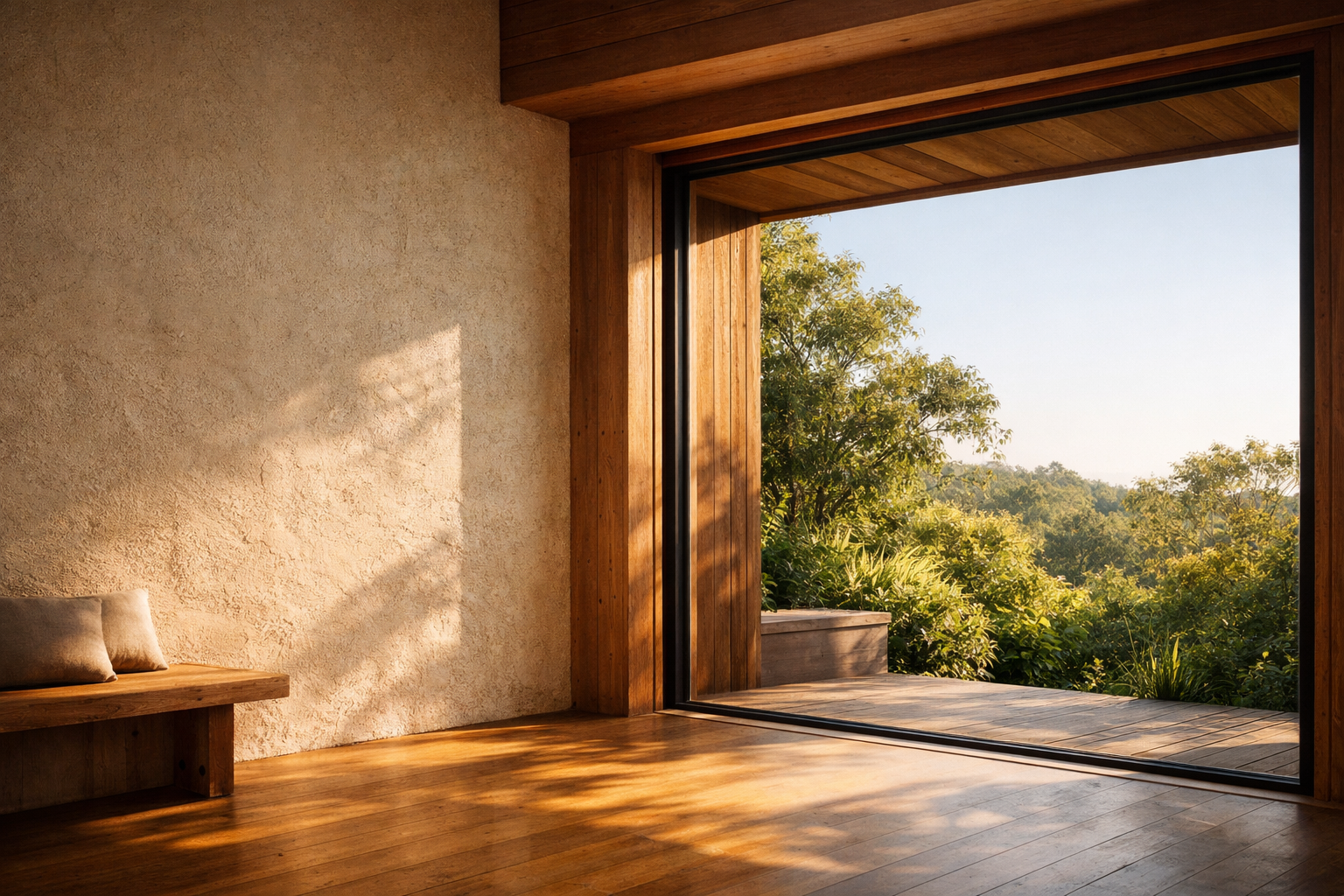
Getting the fundamentals right before the flourish
Biophilic design has become one of those terms that everyone seems to use, but few seem to feel.
It appears in marketing blurbs, sustainability reports, and award citations, often reduced to a checklist of green walls, indoor plants, or timber finishes. Yet when those surface gestures are stripped away, many so-called biophilic buildings still feel strangely inert. Technically competent, visually impressive, but emotionally flat.
This is usually because biophilia has been approached backwards.
True biophilic architecture does not begin with features or products. It begins with first principles, with instinct, biology, and the quiet intelligence of the human body. Only once those fundamentals are in place does nuance, expression, and architectural flair truly matter.
This post is an attempt to return to those basics.
Biophilia is not decoration, it is alignment
The term biophilia was popularised by E. O. Wilson, who described it as humanity’s innate tendency to seek connection with life and living systems. This is not a preference shaped by culture or taste; it is a deep evolutionary imprint.
For over 99 percent of our existence as a species, we lived embedded in natural systems, reading light, weather, vegetation, water, and terrain as cues for safety, opportunity, and belonging. Architecture, in evolutionary terms, is very new. Our nervous systems have not yet caught up.
The implication is simple but profound:
Buildings feel good when they align with the environments we evolved within.
This alignment cannot be achieved through surface gestures alone. It must be structural, spatial, and sensory.
First principle #1: Light before form
Before humans notice shape, colour, or material, the body registers light.
Daylight governs our circadian rhythms, hormonal cycles, alertness, and emotional stability. Poor light creates low-grade stress even when we cannot articulate why a space feels wrong.
At a first-principles level, biophilic architecture asks:
Where does the sun rise and set?
How does light move through the day, not just at noon?
Where does soft light belong, and where does brightness energise?
Good biophilic design prioritises quality of light over formal expression. Rooms are shaped by light, not the other way around. Windows are placed for depth, variation, and shadow, not symmetry or elevation composition alone.
When light is right, many other decisions become easier.
First principle #2: Connection to outside is non-negotiable
A room without meaningful connection to the outdoors is biologically incomplete.
This does not mean every space needs a panoramic view. It means the body must receive information about the wider world: weather, movement, vegetation, time passing.
At an instinctive level, humans seek:
Prospect (a sense of outlook)
Refuge (a sense of shelter)
Awareness (subtle visual or sensory connection beyond the room)
Biophilic architecture carefully choreographs this balance. Even dense urban buildings can offer framed views, borrowed landscapes, sky glimpses, or layered thresholds that keep occupants connected to something larger than the interior envelope.
The aim is not scenery.
The aim is orientation and belonging.
First principle #3: Material honesty matters more than material type
Timber is not biophilic because it is fashionable. Stone is not grounding because it is expensive. Plants are not calming simply because they are alive.
What matters is material honesty.
Natural materials resonate because they behave in ways our bodies understand. They age. They carry texture. They respond to light. They tell the truth about how they were made.
Biophilic architecture favours materials that:
Reveal grain, fibre, or structure
Weather rather than degrade
Feel warm, textured, and tactile at human scale
A single honest material, used well, will outperform a palette of superficial “natural” finishes every time.
First principle #4: The body reads space before the mind does
Long before we think about architecture, we feel it.
Ceiling height affects breathing. Narrow corridors increase tension. Sudden compression and release can either delight or unsettle. These responses happen below conscious thought.
A first-principles approach asks:
How does the body move through this space?
Where does it slow down?
Where does it feel held, and where does it feel exposed?
Biophilic spaces are rarely monotonous. They offer variation, rhythm, and moments of pause. They feel more like landscapes than machines.
This is why many older buildings, despite poor thermal or seismic performance, still feel deeply humane. Their proportions were shaped by bodily experience, not software defaults.
First principle #5: Nature is not an add-on, it is the framework
Perhaps the most common mistake in contemporary design is treating landscape as leftover space.
Biophilic architecture reverses this. It begins with site, climate, wind, water, and vegetation, allowing the building to emerge from these conditions rather than dominate them.
This approach is echoed by thinkers such as Oliver Heath and institutions like the International Living Future Institute, but it is also deeply intuitive.
When the landscape leads:
Buildings feel calmer
Environmental performance improves naturally
The architecture feels inevitable rather than imposed
This is not about romanticising nature. It is about recognising that nature already solves most of the problems we struggle with artificially.
Nuance comes later, and that is okay
Once these fundamentals are in place, architecture can become expressive.
Form, detail, contrast, boldness, and experimentation all have a role. But without first principles, they become cosmetic, flair without foundation.
Biophilic architecture is not about visual softness or rustic aesthetics. It can be urban, robust, and contemporary. What matters is that it remains legible to the human nervous system.
When people say a building “just feels right,” they are often responding to these invisible fundamentals, not to style.
Returning to instinct in a noisy world
We live in an age of visual overload, performance metrics, and architectural spectacle. Against that backdrop, returning to first principles can feel almost radical.
Yet the most enduring architecture has always done this quietly.
It listens.
It aligns.
It respects the intelligence of the body.
For me, biophilic architecture is not a trend or a toolkit. It is a reminder to slow down, strip back, and ask a simple question at every stage of design:
Would this space feel good to inhabit, even if no one explained it to you?
Get that right, and everything else becomes nuance.