Planning Homes or Planning a City? Why Auckland’s housing debate is missing the bigger picture
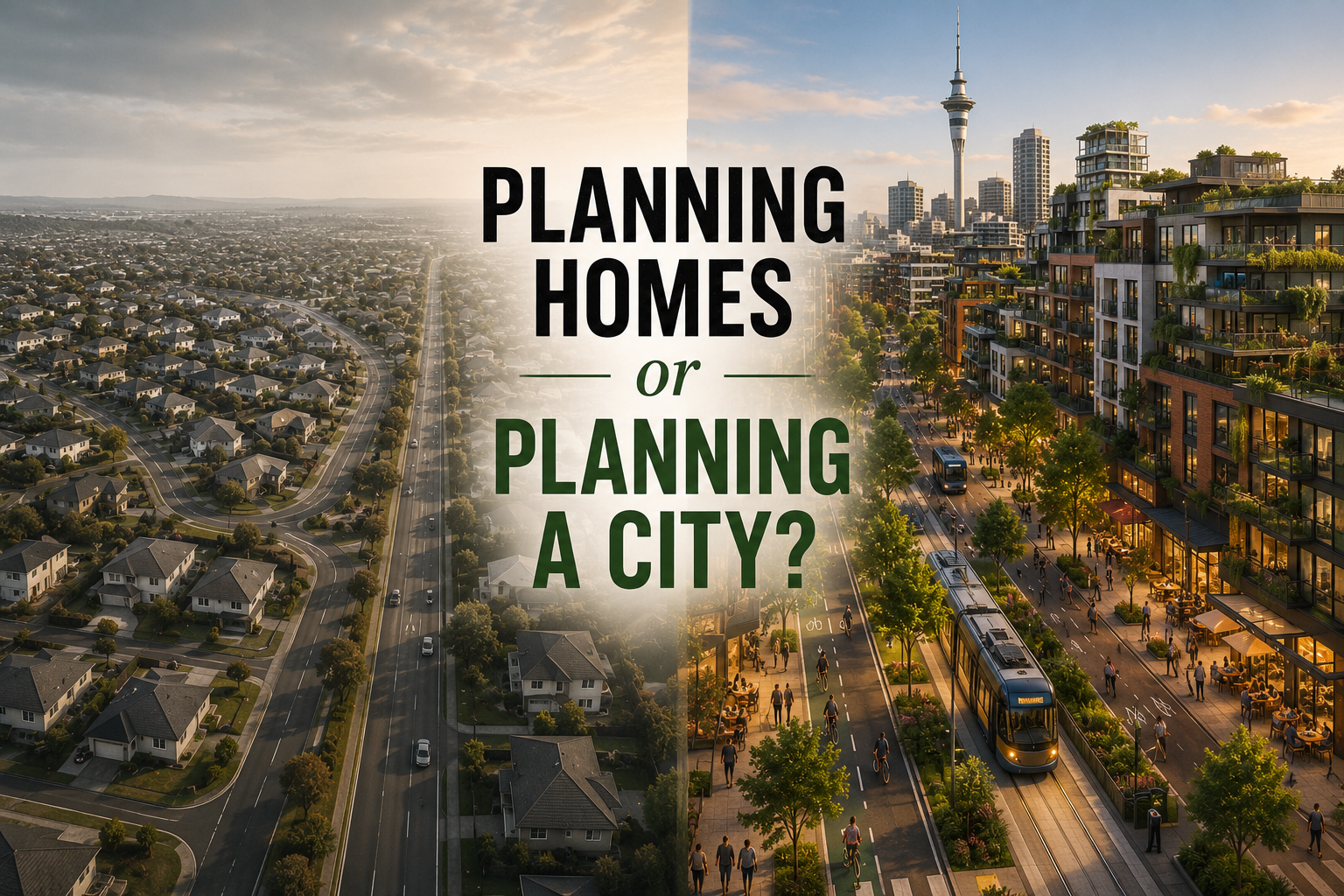
A recent debate about Auckland’s housing intensification raised an interesting question: are we planning homes, or are we planning a city?
Much of the discussion focuses on theoretical housing numbers, zoning capacity, and density targets. While these are important, they risk distracting us from the bigger question of what kind of city we are actually trying to create.
The Auckland Unitary Plan already provides theoretical capacity for approximately 1.2 million homes, while recent proposals suggest that figure could increase to 1.5–1.7 million homes. However, these numbers are theoretical. They assume every site is developed to its maximum allowable density, which simply does not happen in reality.
Development feasibility, infrastructure constraints, lending requirements, market conditions, construction costs, landowner decisions, and community demand all influence what is ultimately built. In many cases, sites that could theoretically accommodate apartments are instead developed as townhouses because that is what the market supports. Planning capacity and housing delivery are not the same thing.
The real question should not be how many homes we can theoretically zone for, but how many quality homes we can realistically deliver.
I strongly support increased density in Auckland. In fact, I believe Auckland must intensify if it is to become a more sustainable, affordable, and vibrant city. Endless outward expansion is neither environmentally nor economically sustainable. We cannot continue consuming productive land and extending infrastructure further and further from the city.
However, density should occur in the right locations and as part of a broader vision for city-building.
Intensification around the City Rail Link stations, metropolitan centres, rapid transit routes, and major transport corridors is essential. These are precisely the places where higher density can support public transport investment, reduce car dependency, and create thriving urban communities. Failing to intensify around this infrastructure would be a missed opportunity.
At the same time, housing cannot be planned in isolation.
Every discussion about adding homes should also include discussion about transport, schools, parks, community facilities, water supply, wastewater infrastructure, power supply, healthcare services, and local businesses. Adding housing for tens of thousands of people without simultaneously planning for where those people will work, shop, learn, and spend their leisure time is not city-building; it is simply moving a problem from one place to another.
In many cases, infrastructure should lead development rather than follow it. It is far easier to build housing once transport and services are in place than it is to retrofit infrastructure after growth has already occurred.
One of the greatest weaknesses of recent planning reforms has been the quality of much of the housing delivered. Many architects, urban designers, and planners would agree that compliance with planning rules does not necessarily result in good urban outcomes. Too often we have focused on housing quantity while paying insufficient attention to design quality, liveability, and the long-term character of our neighbourhoods.
If Auckland is serious about intensification, it should also be serious about urban design quality. Stronger design review processes, better public realm requirements, higher standards for landscaping, and greater emphasis on long-term liveability should be part of the discussion. We should not accept poor-quality housing simply because it increases dwelling numbers.
Equally important is the need to create complete neighbourhoods rather than isolated housing developments.
People do not live in houses; they live in neighbourhoods.
Successful neighbourhoods contain a mix of housing, local shops, cafés, workplaces, schools, parks, community facilities, and public transport. They provide opportunities to meet daily needs close to home and reduce dependence on private vehicles. We need more mixed-use neighbourhoods and fewer areas where housing, employment, retail, and recreation are separated into isolated zones.
Auckland should be developing a network of compact, connected, walkable neighbourhoods rather than simply increasing housing numbers suburb by suburb.
I am also not convinced that Auckland's challenge can be described solely as a housing crisis.
We certainly have an affordability crisis. We have a housing choice crisis. We have a housing quality crisis. We have people struggling to access housing that meets their needs and budgets. However, we should be careful about assuming that increasing theoretical housing capacity automatically solves those problems.
The market currently delivers relatively few genuinely affordable options. Entry-level housing is often beyond the reach of many first-home buyers. We need a wider variety of housing types and price points, including smaller apartments, co-living options, adaptable housing, and alternative ownership models. We need housing options for people at all stages of life and across a wide range of incomes.
Affordability requires more than planning reform. It requires consideration of lending rules, infrastructure funding, construction costs, taxation settings, development feasibility, and housing diversity.
The conversation should also acknowledge that cities evolve over time.
Buildings constructed today may serve very different purposes in the future. Demographics change. Economic conditions change. Population growth rates change. Technology changes. Yet much of our current development is designed around short-term housing targets rather than long-term adaptability.
We should be creating buildings and neighbourhoods that are capable of changing over time. The apartments, offices, retail spaces, and mixed-use developments we build today should be flexible enough to accommodate future needs rather than becoming obsolete when circumstances change.
A resilient city is not one that simply builds more. It is one that can adapt.
Finally, Auckland needs a long-term vision that extends beyond election cycles and political interventions.
Successive changes in government policy create uncertainty, delay investment, consume significant public resources, and force councils to repeatedly revisit planning frameworks before previous changes have had time to take effect. This constant cycle of intervention benefits very few people.
Auckland needs a clear, long-term strategy developed by Aucklanders for Auckland. Central government has an important role to play, but cities function best when they are guided by a consistent vision that survives political cycles.
We need leaders who are prepared to make difficult decisions in the long-term interests of the city, even when those decisions are not universally popular. We cannot allow the future of Auckland to be determined solely by the loudest voices or the shortest political timelines.
The Auckland I would like to see is compact, connected, affordable, green, and adaptable. It would support high-quality density around transport corridors and centres, provide housing options for people of all ages and incomes, protect and expand access to nature, encourage vibrant local businesses, and create neighbourhoods where people can live, work, learn, and connect.
The challenge is not whether Auckland should grow. It is whether we have the vision, leadership, and commitment to build the kind of city that future generations will thank us for.
Michael Davies is the principal architect at Daedal Architecture, an Auckland-based practice focused on creating meaningful buildings, vibrant neighbourhoods and cities that foster deeper connections between people, place and nature.