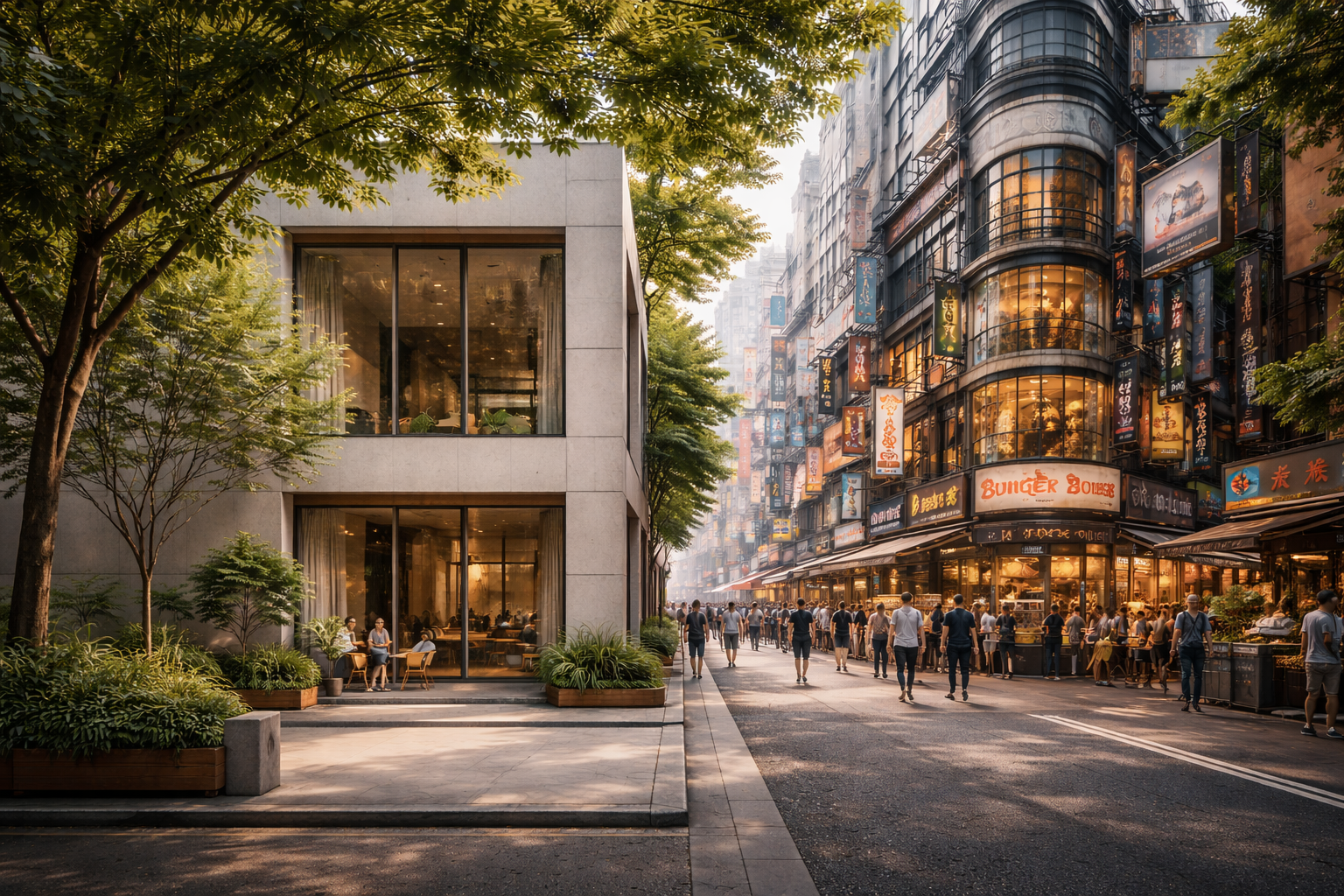
Stripping back complexity to make room for calm, clarity, and care.
In many contemporary buildings there is an assumption that more complexity equals better design. More materials, more forms, more visual statements. Façades layered with multiple systems. Interiors filled with finishes competing for attention. Technology embedded everywhere.
At first glance these spaces can feel impressive. They photograph well. They signal ambition.
Yet after spending time within them, something often feels slightly off. The spaces can feel restless. Overstimulating. Hard to settle into.
Human beings are remarkably sensitive to the environments around them. We constantly process light, sound, texture, movement, and spatial cues, often without realising it. When a building presents too many competing signals, our senses never quite relax.
This is why some of the most humane buildings are often the simplest ones.
Not because they are austere or minimal for its own sake, but because they remove unnecessary complexity and allow the essential qualities of architecture, light, proportion, material, and landscape, to come forward.
Simplicity, in this sense, becomes an act of care.
When Buildings Become Too Busy
Modern construction technology has given architects extraordinary freedom. Almost any form can now be drawn, modelled, fabricated, and assembled. This freedom has produced many remarkable buildings, but it has also introduced a temptation: to use complexity simply because we can.
Many new environments are visually crowded.
Multiple cladding systems sit side by side. Structural elements are exposed and layered. Signage competes with architectural form. Interior spaces are filled with materials that each demand attention.
The result is often a kind of visual noise.
Just as constant background sound can become exhausting, constant visual stimulation can create subtle stress. Our minds are continually interpreting patterns, edges, colours, and surfaces.
The building may be technically sophisticated, but it can still feel strangely uncomfortable.
This is rarely intentional. Designers often aim to create interest and richness. Yet richness does not necessarily come from adding more. Sometimes it emerges when the unnecessary is quietly removed.
Why Simplicity Feels Better
Humans have an innate preference for environments that are legible and coherent.
When spaces are easy to understand, we move through them intuitively. Our attention shifts away from processing the building itself and towards the activities and relationships taking place within it.
Simplicity helps create this clarity.
A room with well-proportioned walls, natural light, and a restrained palette of materials allows the mind to settle. We notice the changing quality of daylight. The warmth of timber under the hand. The quiet rhythm of structure.
Nothing competes unnecessarily for attention.
This does not make the space dull. Quite the opposite. It allows subtle qualities to emerge.
The grain of timber becomes more noticeable when it is not surrounded by a dozen other materials. The movement of light across a wall becomes more meaningful when the surface itself is calm.
Simplicity reveals richness rather than suppressing it.
Simplicity Is Not Minimalism
There is sometimes a misconception that simplicity means minimalism, spaces stripped so bare that they become cold or abstract.
But humane simplicity is something different.
Minimalism can occasionally remove too much. When warmth, texture, and human scale disappear, buildings risk feeling detached from everyday life.
A humane approach to simplicity still embraces sensory experience. Natural materials remain present. Surfaces carry texture and imperfection. Spaces feel grounded rather than sterile.
A simple timber room filled with daylight can feel deeply comforting. Its richness lies not in visual complexity but in the depth of its material and spatial qualities.
In many ways, this kind of simplicity aligns closely with biophilic design. Both approaches recognise that humans respond best to environments that feel natural, coherent, and emotionally legible.
Simplicity as an Act of Care
Architecture shapes how people feel, often in quiet ways that go unnoticed.
A well-considered building can support concentration, calm the nervous system, and create spaces where people naturally gather and interact. A poorly considered one can create tension without anyone fully understanding why.
Designing simpler buildings is one way of caring for the people who use them.
In schools, clarity of space helps students focus. In workplaces, calmer environments support productivity and reduce fatigue. In homes, simple and coherent spaces allow daily life to unfold without constant distraction.
This does not mean buildings should be plain or generic. Rather, they should be intentional about what truly matters.
When unnecessary complexity is removed, the essential qualities of architecture become stronger.
Light becomes more visible. Proportion becomes more meaningful. Materials become more tactile. The presence of landscape becomes more profound.
The building stops demanding attention and instead begins supporting life.
Letting Nature Take the Lead
One of the most powerful effects of architectural simplicity is that it allows nature to take a more prominent role.
When buildings are quieter, the natural world becomes more noticeable.
Trees framed through a window become focal points. Changes in weather alter the character of a room. Shadows move slowly across walls throughout the day.
Instead of competing with nature, architecture becomes a frame for it.
This is where biophilic design often finds its greatest strength. The goal is not simply to insert plants into buildings, but to create environments where the presence of nature feels fundamental rather than decorative.
Simpler architecture makes this easier.
When forms are restrained and materials are honest, landscape, light, and seasonal change naturally become part of the experience of the building.
A Quiet Kind of Architecture
In a world increasingly filled with noise, visual, digital, and sensory, there is growing value in buildings that offer calm.
These buildings rarely announce themselves loudly. They do not rely on spectacle or novelty. Instead, they feel composed, grounded, and quietly confident.
People often struggle to explain why such places feel good to be in.
Yet the reason is usually simple.
The architecture has removed what is unnecessary and allowed what truly matters to remain.
Light. Material. Proportion. Landscape. Human presence.
In this way, simplicity becomes a form of generosity.
By stripping back complexity, architecture creates room for life itself to take centre stage.